

Fleet safety is often measured through outcomes.
How many collisions occurred? How many insurance claims were submitted? What was their total value? How many vehicles were off the road?
These are important measures, but they all share the same limitation: by the time they appear in a report, something has already happened.
If fleet operators want to reduce risk, they need to pay attention to the warning signs that appear before a collision or claim.
The national picture remains complicated
Final government figures for 2025 recorded 1,538 road fatalities in Great Britain, a reduction of 4% compared with 2024. However, the number of people killed or seriously injured increased by 4% to 29,918, while casualties of all severities remained broadly unchanged.
That mixed picture is an important reminder that one headline measure cannot define road safety.
A reduction in one area does not mean that every risk is moving in the right direction. Fleet operators need to understand the behaviours and circumstances sitting beneath the final incident numbers.
Lagging indicators explain the past
Collisions, claims and repair costs are lagging indicators. They tell a business what has already happened.
They are essential for understanding consequences and measuring long-term performance, but they provide limited opportunity to prevent the incident being reported.
Leading indicators offer a different perspective.
These can include:
- Repeated speeding events.
- Harsh acceleration or braking patterns.
- Distraction and fatigue warnings.
- Excessive speed for the road conditions.
- Changes in an individual driver’s usual behaviour.
- Recurring events on a particular route or at a specific location.
- Evidence that operational pressures are encouraging unnecessary risk.
None of these measures can predict every collision. However, they can help fleet managers identify where risk may be increasing and intervene earlier.
The Health and Safety Executive describes driving for work as one of the most dangerous activities workers undertake. It also recognises that telematics and vehicle safety technologies can help employers monitor safety-related events and support learning and improvement.
Improvement can be identified before claims fall
Aggregated Verilocation fleet data provides an example.
Among vehicles in currently active fleets, excluding trailers, speeding events per 100 kilometres fell by approximately 31.1% between December 2024 and December 2025. The rate of recorded harsh-braking events fell by approximately 50.6% over the same comparison period.
Those figures should not be interpreted as proof that future collisions will fall by the same percentage. Road incidents are influenced by many factors, and a harsh-braking event can sometimes demonstrate that a driver reacted correctly to a hazard.
However, these trends can help fleet managers ask better questions.
What changed between the two periods? Was coaching introduced? Did particular drivers improve? Were routes altered? Did vehicle allocation change? Are the improvements consistent across the fleet, or concentrated within a small number of accounts, depots or vehicle types?
The data becomes valuable when it leads to investigation and action.
Drivers must be part of the safety programme
Technology alone does not create a safer fleet.
If safety information is used only to issue warnings or penalties, drivers may see it as surveillance rather than support. That can damage trust and make people less willing to engage with the programme.
Drivers need to understand the purpose of the technology and how it can protect them.
The same systems that identify risky behaviour can also provide objective evidence when a driver is not at fault. They can establish what happened during an incident, defend professional drivers against false allegations and help ensure that decisions are based on evidence rather than assumption.
That protection should be explained from the beginning—not introduced only after drivers raise concerns.
Coaching should also focus on patterns rather than isolated events. A single occurrence may be understandable. Repeated behaviour under similar circumstances may indicate a need for support or a wider operational problem.
Look beyond the driver
In reality, the business may be contributing to the risk.
Unrealistic schedules, poorly planned routes, excessive workloads, unsuitable vehicles and long periods without adequate rest can all influence how somebody drives.
A speeding event may therefore raise a second question: was the driver under pressure to meet an unrealistic arrival time?
A fatigue warning may reveal a problem with shift planning rather than personal responsibility.
A recurring event at one location may point to the road layout or customer process rather than the driver.
Effective safety management examines the system surrounding the driver as well as the behaviour itself.
Measure intervention, not simply information
Collecting more safety data is not the objective.
The purpose is to identify the right intervention and determine whether it worked.
Fleet operators should be able to answer:
- Which risks require immediate attention?
- Who is responsible for acting?
- What support or coaching has been provided?
- Has the behaviour improved afterwards?
- Are similar events occurring elsewhere?
- Has the intervention reduced collisions and claims over time?
Without that process, a safety dashboard can become another record of events rather than a tool for preventing them.
Remember: Prevention must come before the claim
No fleet can eliminate every risk. Vehicles operate in unpredictable environments, and drivers encounter situations the business cannot control.
But fleets can become better at recognising patterns, supporting drivers and responding before warning signs become serious incidents.
Claims data will always matter. Collision figures will always matter.
The strongest fleet safety programmes will also ask what the data was saying before the incident occurred—and whether somebody had the opportunity to act.
I’d be interested to hear how other fleet operators measure safety. Is the focus still primarily on collisions and claims, or are leading indicators now shaping earlier interventions?
OUR AI CAMERA SOLUTION
Strengthening Safety, Reducing Exposure
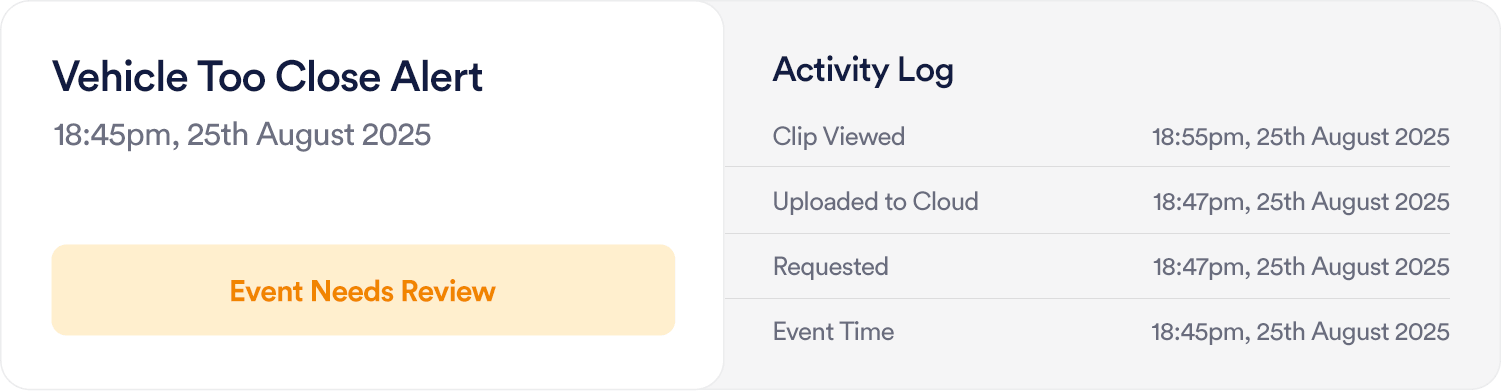
AI camera systems play a central role in modern fleet risk management. By combining real-time alerts, structured coaching and defensible video evidence, operators gain stronger control over safety performance and liability exposure.
- Protect drivers from false claims
Clear footage helps resolve disputes quickly and defend against exaggerated or fraudulent claims. - Reduce accident frequency
In-cab alerts and AI detection encourage safer behaviour before incidents escalate. - Lower insurance risk
Documented evidence and improved driving standards support more informed insurer conversations. - Improve public safety
Blind spot coverage and ADAS alerts help protect vulnerable road users in urban and high-density environments.